
Depression That Keeps Coming Back — or Never Fully Lifted
You may be experiencing:
- →Tried two or more antidepressants without full relief
- →Felt better on medication but never quite yourself
- →Persistent low mood that therapy alone hasn’t resolved
- →Fatigue, hopelessness, or emotional flatness that won’t lift
- →Stopped believing treatment can work for you
- →Side effects from medication that made quitting feel necessary
Treatment-resistant depression affects an estimated 30 to 40 percent of people diagnosed with major depressive disorder. It is not a personal failure — it is a biological reality. The brain regions responsible for mood can become resistant to chemical approaches while remaining responsive to direct stimulation.
Patients across Boca Raton and Fort Lauderdale who have spent years trying to find the right medication often come to us after exhausting those options. TMS is not another medication. It works at a completely different level.
“Treatment-resistant does not mean treatment-impossible. It means the right treatment hasn’t been found yet.”
Antidepressants Work Through the Bloodstream. TMS Works Directly.
Antidepressants regulate neurotransmitters — serotonin, dopamine, norepinephrine — throughout your entire system. For many people this is effective. For others, the specific neural circuits involved in their depression don’t respond to chemical regulation alone.
Side effects are also a significant factor. Weight gain, sexual dysfunction, emotional blunting, and cognitive dulling cause many patients to discontinue medication before it has a chance to work — or to live with symptoms rather than continue a treatment that takes something else away.
TMS bypasses the bloodstream entirely. Magnetic pulses reach the prefrontal cortex directly — the region most consistently underactive in depression — and stimulate it to restore normal function. It works differently because it is different.

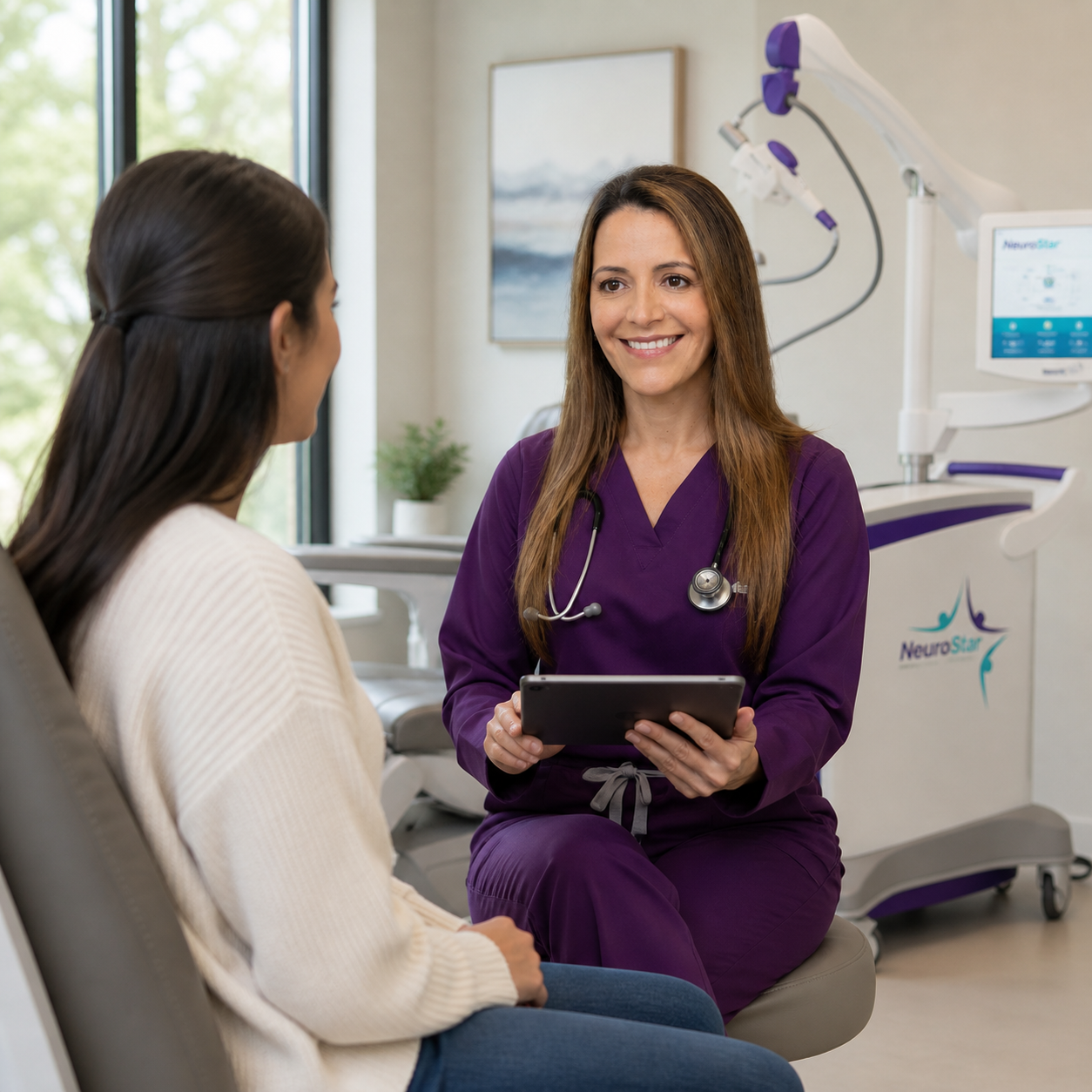
Stimulating the Brain Region That Depression Suppresses
Targets the left prefrontal cortex directly
This is the area most consistently underactive in major depressive disorder. TMS delivers focused magnetic pulses to activate it — not through the bloodstream, but through direct neural stimulation.
Works where medication hasn’t
Because TMS operates through a different mechanism entirely, patients who failed two or more antidepressants still respond. Clinical trials show 83% response rates in this specific population.
No systemic side effects
Nothing enters your bloodstream. No weight changes, no emotional blunting, no sexual side effects, no withdrawal when treatment ends.
20 minutes per session — no downtime
Palm Beach and Broward County patients drive themselves in, complete the session, and go directly back to their day.
Step by Step — From Evaluation to Relief
Free Consultation & Insurance Check
We review your treatment history, confirm your diagnosis, and verify insurance coverage before anything else happens. Most major plans cover TMS for qualifying patients.
Personalized Brain Mapping
Your first session calibrates the NeuroStar device to your specific anatomy — identifying the exact location and magnetic intensity needed for your treatment.
36 Sessions Over 7–9 Weeks
Five sessions per week, approximately 20 minutes each. Patients across South Florida fit this into their workday with no disruption to their schedule.
Progress Monitoring Throughout
We use validated clinical tools to track your symptom changes and adjust the protocol if your response calls for it. You are not left to figure out how it’s going alone.
Sustained Relief
Many patients maintain meaningful improvement for one year or more following treatment. We discuss maintenance options based on your individual response.
Life After Treatment-Resistant Depression
Recovery looks different for everyone. But here is what patients consistently describe.
Waking up without dread
The weight that used to greet you every morning begins to lift. Small things start to feel manageable again.
Reconnecting with people
The withdrawal and isolation that depression creates starts to reverse. Patients describe wanting to be around others again.
Finding interest in life again
Hobbies, relationships, and goals that felt unreachable during depression begin to matter again.
Feeling like yourself
Not a medicated version. Not a diminished version. The self that depression buried — returning.
The Research Behind the Results
of patients in NeuroStar clinical trials — specifically those with treatment-resistant depression — responded to TMS with meaningful symptom reduction.
achieved full remission, no longer meeting the clinical threshold for major depressive disorder after completing a full NeuroStar TMS course.
average duration of sustained symptom relief reported in long-term follow-up studies after completing NeuroStar TMS treatment.
Results based on NeuroStar TMS clinical study data. Individual results may vary.
From People Who Were Where You Are Now
I had been on four different antidepressants over six years. Each one worked for a while, then stopped. TMS was the first thing that actually held. It has been over a year and I still feel like myself.
My psychiatrist called it treatment-resistant. I called it hopeless. TMS changed that. By week six I was sleeping through the night and caring about things again. I hadn’t felt that way in three years.
The side effects from medication were almost worse than the depression. TMS gave me results without taking anything away. No weight gain, no fog. Just gradual improvement over several weeks.
What Patients With Treatment-Resistant Depression Ask
Other Conditions We Help With
Emotional Numbness
Feeling disconnected, flat, or unable to experience joy — often a symptom of long-term depression or medication side effects.
Learn more →
TMS After Antidepressants
If you’ve reached the limit of what medication can offer, TMS provides a clinically proven alternative path forward.
Learn more →
Long-Term Depression
Depression that has lasted years — not just months. TMS has shown strong results for patients with chronic, persistent symptoms.
Learn more →
You Have Not Run Out of Options
A free consultation is 30 minutes. We verify insurance before you commit. If TMS is right for you, we’ll tell you exactly what to expect — before you decide anything.
Important Safety Information
NeuroStar TMS Therapy is indicated for the treatment of Major Depressive Disorder in adult patients who have failed to receive satisfactory improvement from prior antidepressant medication in the current episode. NeuroStar TMS Therapy is only available by prescription. The most common side effect is pain or discomfort at or near the treatment site. This is usually mild to moderate in severity and typically resolves within the first week of treatment. Rare risk of seizure (<0.1% per patient). For full safety information, visit neurostar.com.